
The auction catalogue of 1856 gives us some of the last major information about the salt works as there is a disappointing lack of documentary evidence about the operation throughout this period. The section relating to this part of the property read as follows:
‘The Salt Works, with entrances from Bath Road, comprise the pump room with pumps and lead cistern, show case and store closet for the Cheltenham Salts, engine room with gallery, a 14-horse-power high pressure engine working four pumps: the boiler house with two boilers and other machinery, above which are two large evaporating pans with pumps, steam pipes etc complete; and on the roofs are the cisterns, tanks and pipes, for the supply of hot and cold water to the Baths.
‘The Crystallizing Room, with two crystallizing vats and tank, machine shop with mill for grinding the salts; bottle room with dresser; and store rooms with shelves, dressers etc. In the yard are several wells, with an ample supply of most excellent water, and a large cistern in connection with the evaporating pans; also water closet and coal store.’
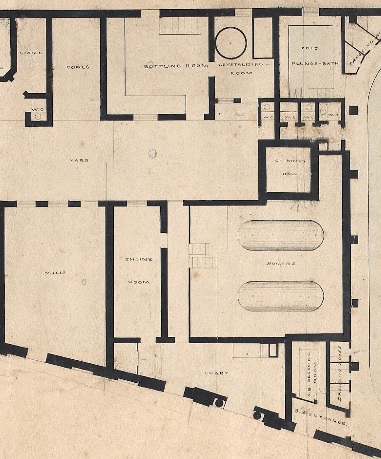
At the beginning of February 1862 the owners of the building, the Globe Insurance Company, agreed to lease it to the newly-established Montpellier Gardens Company and a floor plan was approved by the Globe on 22nd of that month. While it shows the layout at that time it’s impossible to know just how long it had looked like this as any plans made after 1814 – which must have existed – have not survived. Many of the elements from the 1856 auction listing can clearly be seen on this plan but not all of them. Had they been removed or are they down in the cellars with the boilers (note the stairs) where much of the production took place in previous years? The machine shop with mill for grinding salts would still be needed and ought to be positioned close to the crystallizing and bottling rooms – was it above them via the stairs in the latter?
The Company’s annual report for the financial year 1863/64 claimed that the demand for salts had doubled compared with the previous year yet from now on references to the salts become incredibly scarce, almost non-existant in fact. A certain amount of change may have been necessitated by the improvements made to the swimming bath in 1869/70. The widening of the space around the bath for better dressing box accommodation meant that the engine room and the extensive pumping machinery maintained there – which may have been involved in salt production – had to be remodelled plus, as the Cheltenham Examiner of 18 May 1870 put it, ‘the substitution of a massive chimney for the tall taper structure which was formerly one of the landmarks of Cheltenham’. The office in which the spring water was retailed was also enlarged.
From this point on there is total silence on the subject of salts until 1897 and you’d have been forgiven for believing, from the lack of any print coverage anywhere, that production had ceased many years before – perhaps even as far back as the renovations of 1869/70. When the Montpellier Gardens Company tried to dispose of the property by auction in 1895 the announcement referred to ‘the valuable and extensive property well known as The Montpellier Baths including large swimming bath, ladies ditto, a series of 27 warm baths in separate rooms, powerful pumping machinery, a never-failing water supply, fitted laundry, caretaker’s residence etc, together with the important corner shop and premises now occupied by Mr Steel, greengrocer, and the dwelling house adjoining’. There is no mention of the salt works or its equipment.
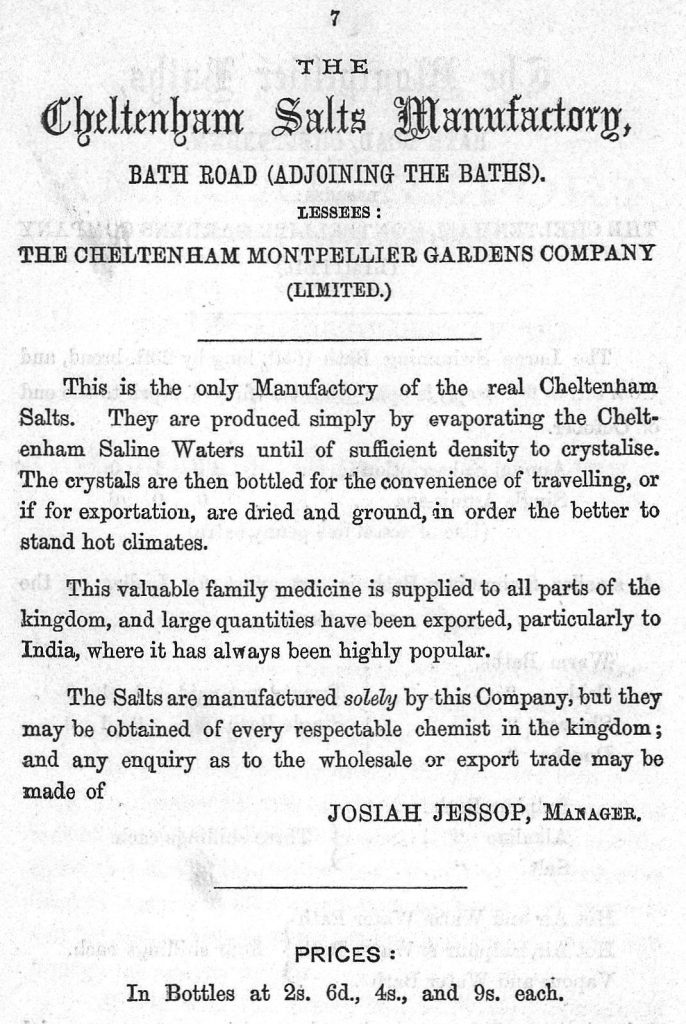
In fact the salts were still being produced throughout this period but a press report of the annual general meeting of the shareholders of the Montpellier Gardens Company for 1897 made it clear that it had been in decline for some considerable time and was, probably, now terminal: the proceeds from the sales of Cheltenham Salts had fallen from a fairly derisory £6 in 1896 to a miniscule £1 12s in the following year. Secretary Mr G Williams said that it was now in the interests of the council to take on the rights to manufacture the salts but Cllr Margrett – a descendant of ‘our’ baker Henry Margrett – observed that this would be futile when no one was buying them. Another shareholder, Mr T Wilkins, had clearly been in recent communication with two wholesale houses that used to buy the salts as he stated that they had told him they would do ‘so again if the salts could be supplied in good condition’. This suggests that the fall in demand may well have been due to a fall in the quality of the product.
One of the shareholders, William Barron, was so concerned about the future of the salts he wrote independently to the Town Improvement Committee ahead of their meeting on 10 November 1897. Not only that, but he must have tipped off someone else about the matter for the minutes record that letters had been received from Barron and a Dr Ward-Humphreys, with both men suggesting that ‘the council should not allow the manufacture of Cheltenham Salts to fall into disuetude, which would be the case if they took no action’. The matter was adjourned until the December meeting at which point the Committee agreed to pay ‘a visit to the Montpellier Baths to inspect the apparatus there, formerly used for the evaporation of the water’ – the use of ‘formerly’ indicates that after the disastrous results at the annual general meeting the plug had been pulled on the salts.
The Committee did inspect the apparatus but at their meeting on 26 January 1898 they adjourned any sort of decision on what should happen; two days earlier the Montpellier Gardens Company had repeated their offer of 1896 to sell the whole building to the council for £2,500. By the end of March the council had voted in favour of purchase subject to a loan from the Local Government. Press reports in June make it clear that the council’s plans for the building included Cheltenham Salts and that there was ‘good prospect that, with renewed machinery, the salts manufacture, once a profitable industry, may be revived’.
The Montpellier Gardens Company closed the baths at the end of the season that October with the council still waiting on funding but William Barron was like a dog with a bone. In December he wrote again to the Town Improvement Committee advocating the resuscitation of the manufacture of salts, stating that the demand for them still continued. By a curious coincidence, the Committee received another letter that month from Messrs Edwards & Son of London enquiring whether the council would supply Cheltenham Salts to the trade and at what price. As the Committee had received no other correspondence on the subject of salts that year, it is tempting to suggest Barron had somehow induced Edwards & Son to write their letter which backed up his point.
The council obtained their loan in 1899 and the premises remained closed while substantial renovations were made but reviving the salts was still very much on the agenda.
TO READ ABOUT SALTS FROM 1900-1944 CLICK HERE